

5 Will County DUI Trial Victories
When Everyone Says Your Case Is Hopeless
My phone rings late at night or the next day. Another Will County DUI arrest. Another client convinced they have no chance.
“I was going 117 miles per hour.”
“I passed out in a McDonald’s drive-thru.”
“I blew .086 on the breath test.”
“I told the cop I needed to ‘sober up.'”
“I have a prior DUI and they’re taking my license for three years.”
These are the calls I get. And here is what I tell every single person: Your case is not over.
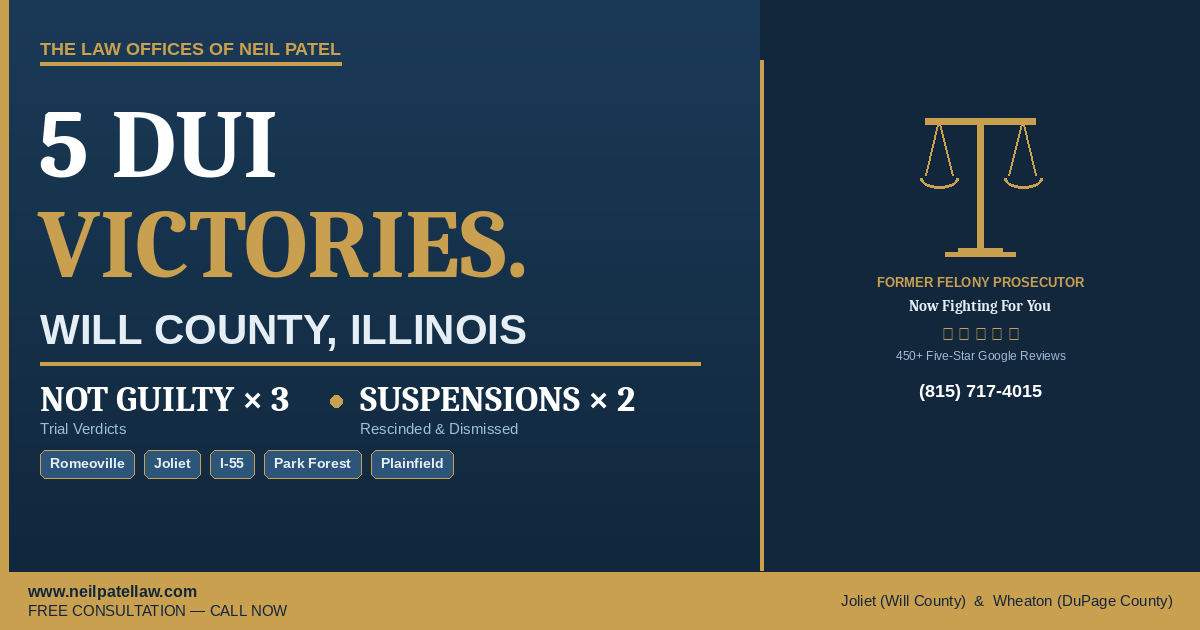
In the first week of February of 2026, we had five DUI victories across Will County. Three resulted in not guilty verdicts at trial. One resulted in a rescinded 12-month CDL suspension. One resulted in a dismissed 3-year license suspension. This is just a sample of the good work that our firm does and can do for you.
Every case had damning evidence. Every case looked hopeless. Every case with the right effort was winnable.
Here is how we did it.
Quick Navigation — Jump to the Case that looks like:
- Case #1: 117 MPH CDL Driver — Romeoville (Suspension Rescinded)
- Case #2: Passed Out in the Drive-Thru — Joliet (Not Guilty)
- Case #3: .086 BAC Excluded — I-55 Will County (Not Guilty)
- Case #4: “I Need to Sober Up” — Park Forest (Not Guilty)
- Case #5: 3-Year Suspension Dismissed — Plainfield
- What These Cases Teach Us About DUI Defense
- What To Do After a Will County DUI Arrest
- Frequently Asked Questions
5 Recent Will County DUI Victories at a Glance:
- ✅ Romeoville: CDL 12-Month Suspension Rescinded
- ✅ Joliet: DUI at McDonald’s — Not Guilty
- ✅ I-55 / Weber Road: .086 BAC Excluded — Not Guilty
- ✅ Park Forest: “Need to Sober Up” Admission — Not Guilty
- ✅ Plainfield / Route 59: 3-Year Suspension — Dismissed
Case #1: The 117 MPH CDL Driver — Romeoville
Result: 12-Month CDL Suspension Rescinded
The Traffic Stop That Could End a Career
Late at night on Independence Boulevard in Romeoville, a Romeoville Police sergeant clocked a driver at 117 miles per hour in a 45 mph zone — more than 70 mph over the speed limit. The pursuit that followed involved extreme speed and erratic lane violations before the vehicle finally stopped.
When officers approached the offending vehicle, the driver was slouched in his seat and appeared to have been passed out. He held his driver’s license in his hand when the officer arrived at the window.
The Evidence Against Him
Physical indicators of intoxication:
- Red, glassy eyes
- Strong odor of alcohol on his breath
- Soft, mumbled, slurred speech
- Could not follow simple directions
- Blank stare, rarely blinked
- Passenger confirmed driver had been “passed out”
Field sobriety test performance:
- Started the Horizontal Gaze Nystagmus (HGN) test
- Showed lack of smooth pursuit in both eyes
- Became frustrated and refused to complete any further tests
Chemical testing: Refused breath test at the police station.
The Stakes: A CDL Career on the Line
This was not just about a DUI charge. As a Commercial Driver’s License (CDL) holder, a 12-month summary suspension means losing the ability to drive commercially — effectively ending a career and eliminating family income. The Illinois Secretary of State automatically issued a 12-month statutory summary suspension for refusing the breath test, with automatic CDL disqualification attached.
How We Won: The State Missed a Critical Deadline
Under Illinois law, when someone receives a statutory summary suspension, the State must provide either a formal hearing or first appearance within 30 days. In this case, the State failed to meet that deadline.
This is not “getting off on a technicality.” This is constitutional due process. When someone’s livelihood depends on their driver’s license, the government must follow its own rules. We filed for rescission based on this statutory violation.
Result: 12-month CDL suspension rescinded. Career saved.
Even with 117 mph speeds, refused tests, and physical signs of intoxication — procedural violations matter. When the State fails to follow its own deadlines, cases collapse.
Case #2: Passed Out in the Drive-Thru — Joliet
Result: Not Guilty
The McDonald’s Incident
Shortly after midnight, Joliet Police responded to a McDonald’s on North Broadway Street in Joliet after dispatch reported a driver passed out in a vehicle in the drive-through line — between the payment window and pickup window.
Officers found a black SUV with the engine running, in park, and the sole occupant appearing to sleep behind the wheel. It took multiple attempts including sternal rubs to wake the driver. Only after the sergeant announced “I’m the Police!!” did the driver fully open his eyes.
The Evidence Stack
Physical appearance:
- Bloodshot, glassy eyes
- Strong odor of alcohol on breath — noted repeatedly in the police report
- Had been unconscious behind the wheel of a running vehicle
His admissions:
- Admitted he had been drinking beer
- Said he consumed “1/4 of a 24-ounce can of Modelo” approximately 30 minutes prior
- Claimed he drank at a friend’s house — but could not identify where that house was
- Wore two wristbands — one reading “SATURDAY,” one reading “VIP” — suggesting a prior event where alcohol was served
- When asked about the wristbands, gave confused, circular answers about attending a concer
Why Most Lawyers Would Have Pleaded This Out
Being found unconscious behind the wheel of a running vehicle in a drive-through line, combined with admission of drinking, and physical signs of intoxication – inexperienced defense attorneys would recommend accepting a reduced charge rather than risk trial.
How We Won: Insufficient Evidence
We took this case to trial. Here is what the prosecution could not prove:
- They could not prove operation while intoxicated. Yes, the vehicle was running and in park — but when was he actually driving? How did he arrive at that McDonald’s? Was he impaired while driving, or did impairment set in after he stopped?
- They could not prove impairment beyond a reasonable doubt. Without field sobriety tests and without a breath test, the prosecution had an odor of alcohol, bloodshot eyes, and confusion when woken abruptly. Is that proof beyond a reasonable doubt?
- They could not prove timing. Maybe he stopped, ordered food, and then drank while waiting. Maybe he was tired, not drunk. The “confusion” may have been from being woken suddenly.
Verdict: Not Guilty.
Refusals can work in your favor. The State still must prove its case. Without test results, officer observations alone often cannot meet the beyond-a-reasonable-doubt standard.
Case #3: .086 BAC Excluded — I-55 / Weber Road, Will County
Result: Not Guilty (Breath Test Suppressed)
The I-55 Crash
In the early morning hours, an Illinois State Police trooper patrolling the I-55 southbound ramp to Weber Road in Will County came upon a crash scene. A white sedan with heavy front-end damage was blocking all northbound lanes on Weber Road. Tire tracks showed the vehicle had crossed over the median from I-55. There was visible curb damage at the exact location of the tracks.
Standing next to the sedan was a 21-year-old driver. When the trooper asked what happened, the driver said he believed he “dozed off” while driving — and initially denied consuming any alcohol, claiming he was “not old enough to drink.”
The Mountain of Evidence Against Him
Physical signs:
- Red, bloodshot, glassy eyes
- Strong odor of alcohol on breath
- Disoriented behavior
- Body tremors throughout contact
- Dry mouth, eyelid tremors
Field sobriety test results — he agreed to perform all tests:
- HGN: 6 out of 6 clues — the maximum impairment score
- Walk and Turn: 5 out of 8 clues — stepped offline, stopped mid-test, improper turn
- One Leg Stand: 1 clue — swaying
- Finger to Nose: Failed 5 of 6 attempts — eyelid tremors, swaying
Chemical testing:
- Roadside Preliminary Breath Test (PBT): .90
- Evidential breath test at station: .086 — over the .08 legal limit
- Refused urine sample
Five separate charges filed:
- DUI — Combination of alcohol, drugs, or intoxicating compound
- DUI — Alcohol
- DUI — BAC .08 or more
- Driving too fast for conditions
- Improper lane usage
This Should Have Been Impossible to Win
A crashed vehicle. Failed every field sobriety test. Maximum impairment score on HGN. A breath test showing .086 — over the legal limit. An Illinois State Police officer with body camera footage. Five separate charges.
How do you beat a case where the defendant blew over .08?
How We Won: Motion to Suppress Granted — Breath Test Excluded
Before trial, we filed a Motion to Suppress all evidence obtained after the arrest. Our argument: the arrest lacked probable cause. The preliminary breath test was improperly administered, and the pre-arrest investigation had procedural deficiencies that rendered the arrest constitutionally invalid.
The court agreed. The Motion to Suppress was granted.
The .086 breath test was excluded from evidence. Breath evidence is out. Without the breath test, the State was left with a crash the driver attributed to dozing off, field sobriety tests affected by potential crash trauma, and subjective officer observations. That was not enough to prove guilt beyond a reasonable doubt.
Verdict: Not Guilty on all five charges.
This case proves the Fourth Amendment matters. Even when you have actually consumed alcohol and blown over .08, if the arrest itself lacked probable cause, everything that follows — including the breath test — gets suppressed. Pre-trial motions are not just paperwork. They win cases.
Case #4: “I Need to Sober Up” — Park Forest
Result: Not Guilty
The Traffic Stop
Late one evening in Park Forest, a sergeant observed a black BMW committing multiple traffic violations on Sauk Trail — repeatedly crossing lane dividers, veering right then left, riding on the left lane divider, and straddling the center turn lane.
The sergeant also noticed: no visible registration plate on the rear of the vehicle (it was hidden behind a tinted rear window). When emergency lights were activated at Sauk Trail and Western Avenue, the car did not stop. It continued south on Western Avenue past Monee Road. Even after the siren was activated, the vehicle kept going — finally curbing only after passing Steger Road.
The DUI Evidence
When the sergeant made contact with the driver:
- Strong odor of alcoholic beverage emanating from breath
- Bloodshot, glassy eyes
- Slurred speech
- Asked about his last drink: said “around 9am,” then corrected to “9pm”
- Asked how many drinks: said “maybe one,” then admitted “one drink and about 3 beers at 9pm while watching the game”
The Damning Admission Before Field Tests
Before beginning field sobriety tests, the driver asked to urinate — which was allowed. Then he asked for a minute before performing the tests. When the sergeant asked why he needed a minute, the driver responded:
“Need to ‘sober up.'”
He added that he had worked all day. This is an admission of intoxication — acknowledging he needed to become more sober, meaning he was currently not sober enough to perform the tests.
Field Sobriety Test Results
- HGN: 6 out of 6 clues — maximum impairment score
- Walk and Turn: 3 clues — could not assume starting position, stepped off line, missed heel-to-toe on 12 of 18 steps
- One Leg Stand: Refused — argued with the officer for approximately 4 minutes about the instructions before refusing entirely
- Breath test: Refused
Seven charges filed: DUI — Alcohol, Improper Lane Usage (×2), Improper Display of Registration, Failure to Yield to Emergency Vehicle, Suspended Registration, Operation of Uninsured Motor Vehicle.
Why This Looked Unwinnable
Count the problems: verbal admission of needing to “sober up,” flight from police, changed story about alcohol consumed, maximum HGN impairment score, failed walk and turn, refused one leg stand after arguing, refused breath test, seven separate charges. Any one of these might be explainable. All of them together? Most lawyers would say plead guilty.
How We Won: Insufficient Evidence
We took this to trial and argued:
- “Sober up” does not necessarily mean “currently intoxicated.” It could mean “wake up,” “clear my head after a long work day,” or “feel more alert.” Words matter — and context matters.
- Field sobriety tests have limitations. HGN can be affected by medical conditions, fatigue, eye problems, and testing conditions. The walk and turn was performed after a full work day under stressful conditions.
- The State must prove impairment beyond a reasonable doubt. Officer observations, field test performance, and one ambiguous comment might create suspicion — but suspicion is not proof.
Verdict: Not Guilty.
Even the most damning admissions are beatable. Trials are not about what looks bad — they are about what the prosecution can prove beyond a reasonable doubt. We held the State to its burden. They did not meet it.
Case #5: 3-Year Suspension Dismissed — Plainfield / Route 59
Result: Three-Year Suspension Dismissed
The Plainfield Incident
Near the Taco Bell and Binny’s Beverage Depot on Route 59 in Plainfield, police observed a driver outside his vehicle urinating. After urinating, the driver returned to his car and fell asleep. Police made contact with the driver in this state.
The DUI Evidence
When the officer made contact with the driver:
- Strong odor of alcoholic beverage emanating from breath
- Bloodshot, glassy eyes
- Slurred speech
- Confused, lethargic speech, slow to wake up, failed to respond to verbal commands
The High Stakes: A Three-Year Suspension
A three-year statutory summary suspension in Illinois indicates prior DUI history within the past five years. This was not a first-time offender situation. For someone with a prior DUI, the stakes are severe — three years without a license means potential job loss, family hardship, and in many cases financial ruin.
Courts are less sympathetic. Prosecutors are less willing to negotiate. Most lawyers would tell this client to expect the worst.
How We Won: The Arrest Lacked Probable Cause
We challenged the underlying arrest. The key question: Does urinating outside your vehicle and then falling asleep in a parked car constitute probable cause for DUI?
The answer is no.
Being in a parked car while intoxicated is not the same as driving under the influence. For a DUI arrest, police need probable cause that the person operated the vehicle while impaired. In this case:
- No one witnessed him driving
- No erratic driving pattern was observed
- The vehicle was parked
- The driver was initially outside the vehicle
The arrest lacked sufficient probable cause. Without a valid arrest, the entire case — including the three-year suspension — collapsed.
Result: Three-year suspension dismissed.
Even with prior DUI history, every new case must be proven on its own merits. A bad arrest is a bad arrest — regardless of what is in your past.
What These Five Cases Teach Us About DUI Defense in Will County
1. The State Must Follow Its Own Rules
DUI victories happen because the State missed a 30-day deadline. This was not luck — this was knowing Illinois DUI law and holding the government accountable to it. Procedural requirements exist for a reason. When the government fails to follow them, cases get dismissed and suspensions get rescinded.
2. Refusals Don’t Mean Automatic Conviction
Four of these five cases involved breath test refusals. In three of them, the refusal strategy contributed directly to the victory. You have a Fifth Amendment right to refuse self-incrimination. Refusal creates consequences — an automatic 12-month suspension — but it also deprives the prosecution of their strongest evidence.
3. Failed Field Sobriety Tests Are Beatable
Two of our clients scored 6/6 on HGN — the maximum impairment score — and both were found not guilty. Field sobriety tests are subjective, affected by non-alcohol factors including medical conditions, fatigue, anxiety, and road conditions. They are one piece of evidence, not conclusive proof of guilt.
4. Breath Tests Over .08 Can Be Excluded
Our I-55 client blew .086 — over the legal limit — and was found not guilty. How? By challenging the legality of the arrest before the breath test was even administered. When a Motion to Suppress is granted, the breath test result is excluded and the jury never sees it. Pre-trial motions matter more than most people realize.
5. Admissions of Drinking Aren’t Fatal
Multiple clients in these cases admitted to drinking. One even said he needed to “sober up.” All were found not guilty. Drinking alcohol is not illegal — driving while impaired is illegal. The prosecution must prove impairment while operating the vehicle, not just that you consumed alcohol at some point earlier in the evening.
6. Prior DUI Doesn’t Disqualify You from Winning
The Plainfield case involved a three-year suspension — indicating prior DUI history within five years. We still won. Every case must be proven on its own merits. Prior convictions do not give police the right to arrest without probable cause on a new charge.
7. Location Does Not Determine Outcome
We won cases against the Romeoville Police, Joliet Police, Park Forest Police, Plainfield Police, and the Illinois State Police. Different jurisdictions, different officers, different procedures — but the same constitutional protections apply everywhere in Will County.
What To Do After a Will County DUI Arrest
In the First 48 Hours
1. Contact a DUI defense attorney immediately. You have 90 days to challenge your statutory summary suspension — but the sooner you act, the better. Evidence preservation begins now.
2. Do not discuss your case with anyone. Not friends, not family, not on social media. Everything you say can potentially be used against you.
3. Write down everything you remember while it is fresh:
- What you ate and drank — specific amounts and timing
- Any medical conditions or medications you take
- How much sleep you had
- Road conditions, weather, and lighting at the time of the stop
- Exactly what the officer said and did — in order
- Whether any witnesses were present
Within the First Week
4. Request body camera footage immediately. Body camera footage is often the best defense evidence available — but it must be requested before it is overwritten or lost.
5. Preserve all other evidence as needed:
- Receipts from restaurants or bars showing your timeline
- Credit card statements
- Medical records if you have conditions that could affect field test performance
Within 90 Days
6. File your summary suspension petition. You have 90 days from the date of arrest to challenge your license suspension. This is a separate proceeding from your criminal case. You can win your license back before the criminal case ever goes to trial — exactly like the Romeoville CDL case.
7. Demand full discovery from the prosecution — learn more about the Will County court process here:
- All police reports
- Body camera footage
- Dash camera footage
- Breath machine calibration and maintenance records
- Officer training and certification records
- Dispatch recordings
8. File pre-trial motions aggressively. Challenge, the stop, the arrest, the breath test. Challenge the field test administration. If the arrest lacked probable cause — like in the I-55 case — everything that follows can be suppressed.
Why The Law Offices of Neil Patel Wins DUI Cases Others Won’t Take
Former Prosecutor Experience
As a former felony prosecutor, I know exactly how the State builds DUI cases — and more importantly, I know where the weaknesses are. I do not just hope for reasonable doubt. I know where to find it.
We Actually Go to Trial
Many DUI attorneys never try a case. They negotiate plea deals and call it defense. Three of these five victories were trial wins — not plea bargains. We fight.
Aggressive Motion Practice
The .086 breath test in the I-55 case did not disappear on its own — we filed a Motion to Suppress and convinced a judge to exclude it. The CDL suspension in the Romeoville case did not rescind itself — we held the State to its statutory deadline. Winning happens in pre-trial motions, not just at trial.
We Know Will County
We have won cases against Romeoville Police, Joliet Police, Park Forest Police, Plainfield Police, and the Illinois State Police. We know the officers, the prosecutors, the procedures, and the courtrooms. Local knowledge matters.
We Don’t Sell Fear — We Tell the Truth
My approach has always been: “I don’t sell fear. I tell the truth.” I will tell you honestly what your case looks like, what your options are, and what I can realistically do for you. Sometimes that means trial. Sometimes it means a motion to suppress. Sometimes it means negotiating a favorable plea. Every case is different.
But I will never tell you your case is hopeless — because these five cases prove it never is.
Frequently Asked Questions: Will County DUI Defense
Should I have refused the breath test?
It depends on your situation. Refusing creates an automatic 12-month suspension (or 3 years with prior DUI history), but it also deprives the prosecution of their most powerful scientific evidence. In four of these five cases, refusing tests was a contributing factor in the defense strategy. Every case is different — this is exactly why you need to call an attorney immediately after an arrest. In the long run, the best advice it to refuse all testing. Learn more here.
I failed field sobriety tests. Is my case hopeless?
No. Two of our clients in these cases scored 6 out of 6 on the HGN test — the maximum impairment score — and both were found not guilty at trial. Field tests are subjective, affected by many non-alcohol factors, and routinely challenged in court.
I admitted to drinking. Can I still win?
Yes. Drinking alcohol is not illegal. The State must prove you were impaired while operating the vehicle — not just that you consumed alcohol at some point. Multiple clients in these cases admitted drinking and were still found not guilty.
Can you really beat a breath test result over .08?
Yes — if the underlying arrest was illegal, the breath test result gets suppressed through a Motion to Suppress. That is exactly how we won the I-55 case. The jury never saw the .086 result. Constitutional rights apply regardless of what the machine says.
I have a prior DUI. Am I going to lose?
Not necessarily. Every case must be proven on its own merits. Prior DUI history makes things more difficult and increases the stakes — but it does not give police the right to arrest you without probable cause on a new charge. We won a three-year suspension dismissal for a client with prior DUI history.
What happens if I don’t fight my summary suspension?
It automatically takes effect on the 46th day after your arrest. For first-time refusals, that means 12 months without a license. For repeat offenders, it means 3 years. You have 90 days to file a petition to rescind. Do not let that deadline pass without calling an attorney.
How much does it cost to hire a DUI defense attorney?
It depends on the complexity of your case, the charges involved, and whether it goes to trial. Call our office for a free consultation. We will evaluate your specific situation and provide a clear, honest fee structure with no surprises.
Your Case Is Not Over
117 MPH. .086 BAC. “I need to sober up.” Prior DUI. We won all five.
If you have been arrested for DUI anywhere in Will County — Romeoville, Joliet, Park Forest, Plainfield, Lockport, Crest Hill, Bolingbrook, or anywhere along I-55 or Route 59 — call us today for a free consultation.
Offices in Joliet (Will County) and Wheaton (DuPage County)
We don’t sell fear. We tell the truth. And we win cases.
We Handle All Will County DUI-Related Matters:
- DUI Defense — First Offense, Second Offense, Aggravated DUI
- CDL / Commercial Driver DUI Defense
- Statutory Summary Suspension Rescission Hearings
- Motion to Suppress (challenging illegal stops and arrests)
- Aggravated Speeding (26 mph or 35+ mph over limit)
- Reckless Driving
- Traffic Violations
- License Reinstatement
Charged with DUI in DuPage County or Will County?
Attorney Neil Patel is a former felony prosecutor who has handled hundreds of DUI cases across the 18th and 12th Judicial Circuits. He knows how the State builds its cases — because he used to build them. If you have been charged with DUI in Wheaton, Naperville, Downers Grove, Bolingbrook, Lisle, Aurora, Lombard, Glen Ellyn, Joliet, or anywhere in DuPage or Will County, contact our office today for a free, confidential consultation.
Se habla español • Wheaton Office (DuPage County) • Joliet Office (Will County)
Attorney Advertising. Prior results do not guarantee a similar outcome. Each case is unique and must be evaluated on its own facts and circumstances. The case results described in this article represent real matters handled by The Law Offices of Neil Patel. All client names and personally identifying information have been removed to protect confidentiality. These results should not be interpreted as a guarantee or promise of a particular outcome in your case. The information on this page is for general informational purposes only and does not constitute legal advice. Consult with a qualified DUI defense attorney regarding your specific situation.
